History
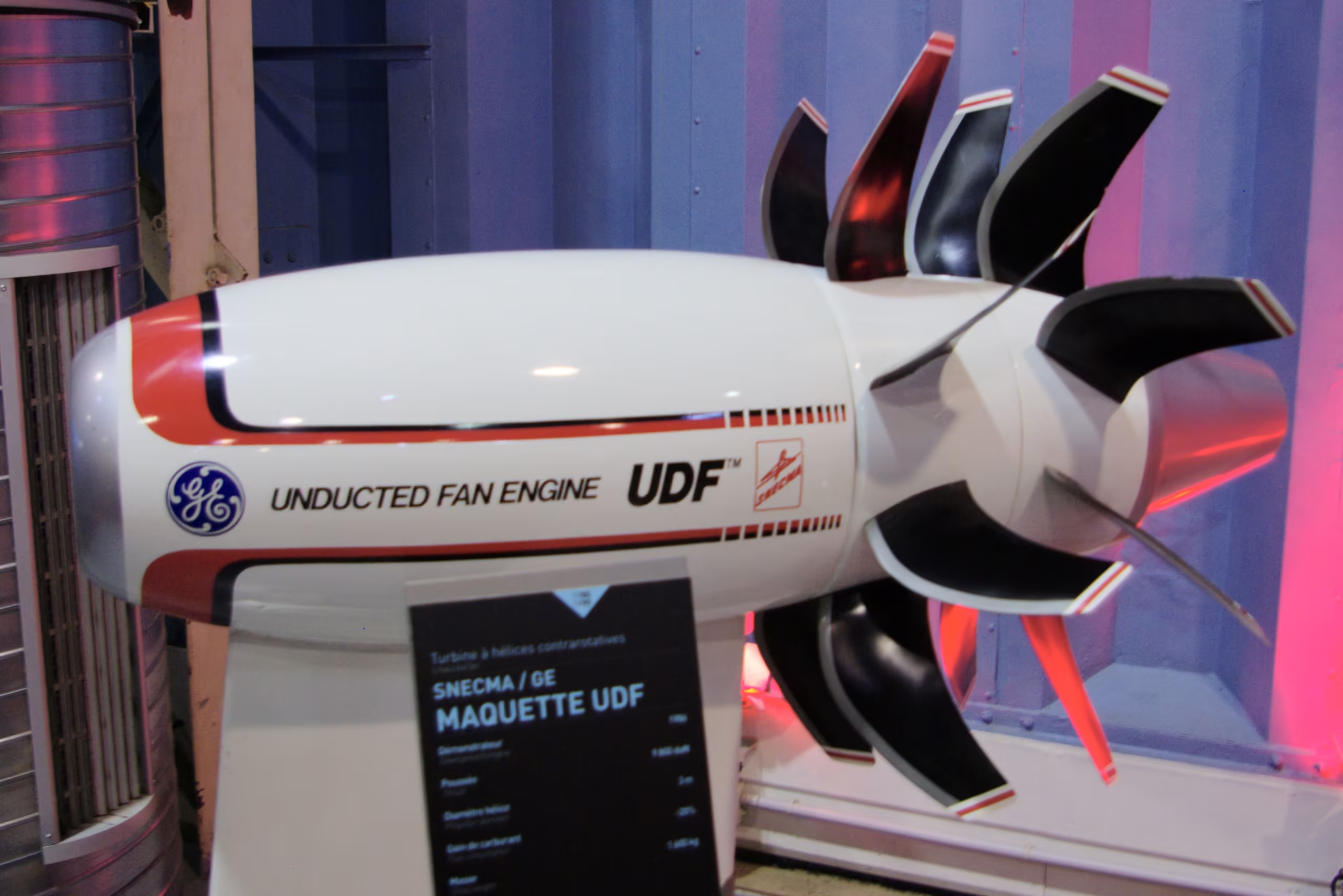
General Electric GE36 was an experimental aircraft engine, a hybrid between a turbofan and a turboprop, known as an unducted fan (UDF) or propfan
Design

A General Electric F404 military turbofan on loan from the American government was used as the basis for the GE36 prototype.The F404 mixed exhaust stream discharged through a turbine which drove two contra-rotating stages of fans. Although the demonstrator engines had 8×8 and 10×8 fan blade configurations, the most efficient setup that was tested had a 12×10 blade configuration. The scimitar shape of the fan rotor blades could operate at high velocities to match turbojet or turbofan speeds, allowing the engine to power the proposed Boeing 7J7 airliner at a Mach 0.83 cruise speed. The production blades for the MD-91/MD-92 versions of the engine were to be designed for Mach 0.78–0.80 cruise.
The UDF fan blades were 40 in (100 cm) in length, and the Rohr Industries-made rotating cowls that fit around the base of the blades were 62 in (160 cm) in diameter.The blades for the initial tests were manufactured directly by General Electric, but the blades for the flight tests were then made by local Ohio manufacturer Hartzell Propeller. For the production engines, the blades were to be made by British composite propeller specialist Dowty Rotol. The maximum fan diameter for the UDF demonstrator was 140 in (356 cm), while the maximum diameter for the UDF production engines was planned to be 128 in (325 cm).During the prototype/testing phase, the fan blades weighed 22.5 and 21.5 lb (10.2 and 9.8 kg) each on the front and back propellers, respectively, but they were expected to weigh less than 20 lb (9.1 kg) by the time the engine entered production.
While the GE36 demonstrator had a rated thrust of 25,000 lbf (110 kN), the GE36 family of engines would offer a range covering 12,000 to 30,000 lbf (53 to 133 kN) of thrust. The engine was initially sized to produce 14,000 lbf (62 kN) for the MD-91X and 20,000–22,000 lbf (89–98 kN) for the 7J7 and MD-92X,but the thrust requirements were later changed to 22,000 lbf (98 kN) and 25,000 lbf (110 kN), respectively