
History
In May 1930, Boeing had flown its Model 200 Monomail single-engined mailplane. The Monomail was of radical design for the time, being a semi-monocoque, stressed skin cantilever monoplane with a retractable undercarriage. Air Corps bomber squadrons of the day were largely equipped with slow strut-braced biplanes built from steel-tube frames covered in doped fabric, such as the Keystone B-6, and Boeing decided to design and build a twin-engined bomber using the same techniques used in the Monomail to re-equip the Air Corps.
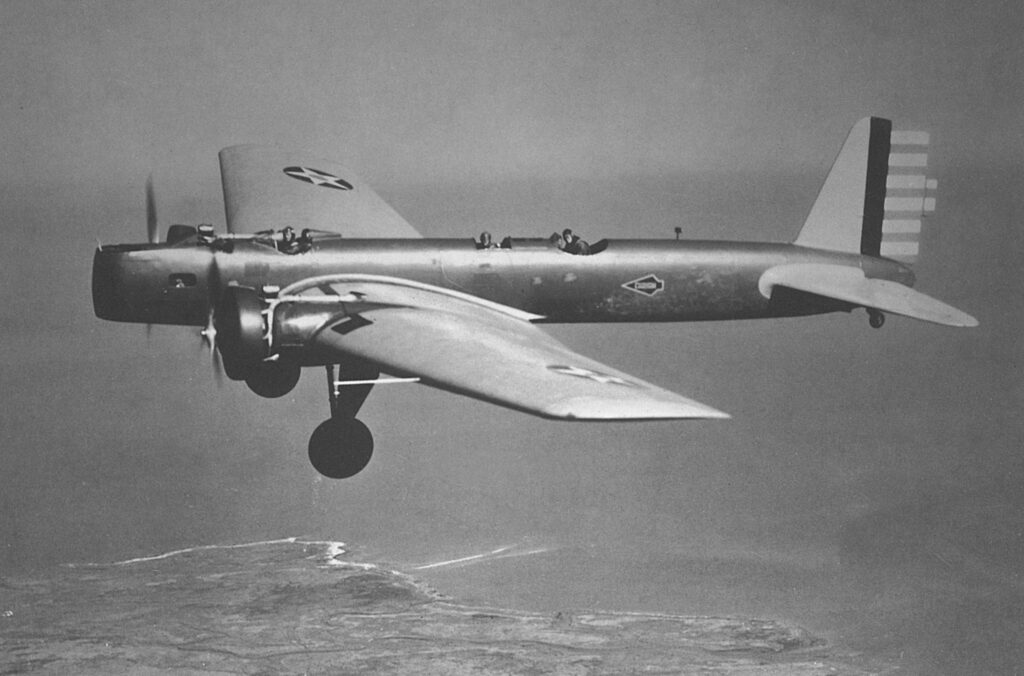
Boeing built two prototypes of a new bomber as a private venture, which differed in the engines used, with the Model 214 powered by two liquid-cooled Curtiss V-1570-29 Conqueror engines while the Model 215 had two Pratt & Whitney R-1860 Hornet B radial engines. Both aircraft were low winged cantilever monoplanes with a slim, oval cross-section fuselage accommodating a crew of five. The pilot and co-pilot sat in separate open cockpits, with the co-pilot, who doubled as the bombardier sitting forward of the pilot. Two gunners, each armed with a single machine gun sat in nose and dorsal positions, while a radio operator sat inside the fuselage. Like the Monomail, a retractable tailwheel undercarriage was used.
The first of the two prototypes to fly was the radial powered Model 215 which, carrying civil markings and the aircraft registration X-10633, made its first flight on 13 April 1931. It was leased to the Air Corps for testing under the designation XB-901, demonstrating a speed of 163 mph (262 km/h). Testing was successful, and both the XB-901 and the as-yet incomplete Model 214 were purchased as the YB-9 and Y1B-9 respectively on 13 August 1931, with an order for a further five for service testing following.
The Y1B-9 (Y1 indicating funding outside normal fiscal year procurement), powered by two liquid-cooled Curtiss V-1570-29 ‘Conqueror’ engines, first flew on 5 November 1931. The increased power from these engines, combined with improved streamlining of the engine nacelles, increased its top speed to 173 mph (278 km/h). The YB-9, meanwhile, had been re-engined with more powerful Hornet Bs, demonstrating slightly better performance than the Y1B-9, which was therefore also re-engined with Hornet Bs.
The five Y1B-9A service test aircraft (Boeing Model 246) had the Pratt & Whitney R-1860-11 Hornet B engines which powered the re-engined YB-9 and Y1B-9 and a redesigned vertical stabilizer modeled on the 247D transport. While enclosed canopies were considered and designed, the B-9 was never fitted with them.Although it equaled the speed of existing American fighter aircraft,[9] no further aircraft were built, as the Glenn L. Martin Company had flown a prototype of a more advanced bomber, the XB-907, which was ordered into production as the Martin B-10
